11 October 2007

A practical understanding of what constitutes a memo - P2.


MEMO-MANAGEMENT-MEMO-MANAGEMENT-MEMO-MANAGEMENT-MEMO-MEMO-MEMO

Now. Now you can all stop pretending that you don’t have the tools for structuring comprehensive policy implementation training sessions. If you’re going to construct mandatory training sessions notification and do it effectively, you'll never get out of the gate without specificating compulsory adherence to The 2 Stipulating Memo Principles.

1) All memo narrative forms are replaced by the 2nd person. Often mistaken for personal, this voice lets you maintain control of your memo by referring to all recipients as a de-individualized collective. “You all” is the preferred form of conveying non-directive warm fuzzies; and complimenting good performance at or near the outset is longstanding memo tradition, on the theory that you must give before you get.

2) Participles form the foundation around which all other useful linguistic qualifiers are gathered. Because participles indicate motion but are in fact staid; and because they so strongly imply an expiring timetable but are in fact tenseless, the standing HR participle policy has been 5 participles per memo paragraph of not more than 4 lines, known colloquially at the policy management level as the “5P4” strategy, with which you are familiar.

The company is expanding; the partners are optimistic that growth can be profitably contained, but they kindly ask that all managers adopt the new, highly evolved 7PP4P memo policy right away: no less than 7 participles per 4-line memo paragraph. 7PP4P has been rigorously trial-tested and shown to result in memos that communicate a sense of more pressing responsibility than ever before, while feeling no less organic.

10 October 2007

you can't do that to shatner.


my friend marlise has a new book out, about the years right after college when she magically created herself a job as a reporter for the globe. i just bought it yesterday, and am really enjoying it; one of the early highlights is her getting into william shatner's 50-guest wedding reception by pretending to be drunk and pee in the bushes--this after being turned away at the gate, to which she brought a big lavender tiffany's box with a pickle dish in it.

this led to a fun email string -

i've always liked you, marlise. and now ... what can i do but marvel at the retardedly high extremes of likeability to which you've traveled: you brought a pickle dish to william shatner's wedding... you gave william shatner a pickle dish. a tiny wittle dish in a big purple box, for him to put his pickles in
.
--
a great deal of thought went into that purchase. it was either that or a key chain, but the key chain would have come in a pouch. couldn't do that to shatner.
--
1) no, i don't expect you could

2) couldn't do that to shatner is destined to become a fantastic hit song, a party song, maybe with a scissor sisters disco rock kind of sound, like

3) whoa-oh / you can't do that to the shat / no no / can't get on the list / put his pickles in a dish, oh no / i said you can't / can't ride the shatner / dip his fish in your batter / oh yeah / best bring a platter / or a dish if you wish / to ever do that to shatner / if you wanna do that to the shat / oh yeah / oh, no.


tabloid prodigy is great fun. click the entry title to go to marlise's site.

09 October 2007

gertrude box redux.

..apsi has just received a comment on our first-ever post, and it's marvelous.

Anonymous has left a new comment on your post "how about Pandora. no? then let's go with Gertrude...":

Hey there! You're talking about my GREAT GRANDMA! She happens to be a great great grandma at this point X 4!

Gertrude Box (or grandma gert as we called her) is an eccentric and wonderful person.

She is 86 years old and is the quintessential life-long learner, but she didn't start her formal college education until after she left her husband at 50 years old!

She has swam in the senior olympics

She has given birth to eight children

At 86, she can still do at least three pull-ups, as she demonstrated at our last family reunion

Quick! Someone do a documentary before she kicks the bucket sky-diving!

http:www.jeanjitomir.com

the post itself was a rich prelude to the sartorial sophistication that would come to define apsi.

i have a thing for the notion that a name plays a role in dictating character. ...really it's a cheap subset of the question as to whether fate determines character or character determines fate -- but that's not exactly a top-shelf philosophical wondering to begin with. so whatever; it's a fun thing to ponder.

especially when today i return to my phd database [am temping at the UW college of education on a study tracking the career paths of phds in certain disciplines] and set about the task of uncovering the current residence of one Gertrude Box. ah, pardon: dr. gertrude box. she has two phds.

go ahead! say it aloud a few times. gertrude BOX. gerTRUDE box.

GERTRUDE! BOX!

strangely freeing, isn't it? it took a while but i finally tracked her down; she was a tough nut to crack. box to open. whichever.

and, if your mind is anything like mine--a generally unhelpful combination of scornful and lazy--you have to wonder what kind of person gertrude box, phd is: whether she eats wheat; if maybe when she laughs her face looks the same as when she takes a shit. that kind of thing.

i looked up the acknowledgements page of her sociology dissertation, to look for references to other family/spousal members who have more easily researchable names. and, jackpot:

"to my father, reverend harry thomas morrell, ba, bd, bph, ma, phd, and to my eight children - trudy, terry, ted, twinkle star, tom, tim, tiara and todd ... but especially to twinkle star."

well, i mean, DUH. of course it was twinkle star box who helped you, who did ALL the typing of your disseration about development of a metric for "the sociological impact of recreational parachuting." because, you know, she had the time.

02 October 2007

black dogs : ian mcewan.


There’s a savory depth to this book. When I pull back enough to think of the whole work conceptually, it’s the layers of the pie that first demand comment. McEwan gives us a novel posed as a memoir, with two very different but inseparable narrative threads pulled by the intellectual and spiritual biographies of the writer’s parental in-laws, who, though still married, are long estranged; the primary crisis having arisen very early on, back in the 1950s, when they belonged to the Communist Party. Fun and romantic, he gangly and she graceful, both of them drowned in idealism—a pair of smiling and hopeful young British communists.

They’re early in their marriage, hiking in the European mountains, when June, the wife, has a Hitchcockian encounter with two black dogs that lastingly alters her belief in the order of things. The black dogs, who may or may not be instruments of terror biologically engineered by the Nazis but left behind after the occupation, do away with June’s inclination and/or ability to hold herself according to the rational nature of life. Her husband, Bernard, veers exclusively to logical layer of the pie, and his affinity for the Party is largely explained in this way, as being a logical framework to bring people even-handed solutions. Bernard was up the path a ways when the dogs confronted June, having been held up by these fascinating insects he was compelled to count the legs on, or something.

This, the encounter to which the title speaks, is the centerpiece of the whole arrangement; it’s the pithy center of the pie, of what’s compelled our narrator to seek out the stories and tacit counsel of the couple, the two separate parts of this diametrically opposed pair.

Why do you sound like you’re trying to write the stuffiest 10th-grade book report ever?
you ask. You said you were gonna talk about the “layers of the pie”—which sounded kinda like crap at the time, but that was before you started to see how many syllables you could fit into a sentence without being interesting. You make a good point. The crazy part is that I’ve stuck to my notes so far—it’s just that I’m still relating to you the details that evoke the first part of my first point, which is the backwardness of the whole affair:

- The encounter with the black dogs is the denouement of a relationship that would continue for decades after

- Said encounter makes up the title, and is alluded to throughout the book, but is only told to us right near the end, like a proper denouement

- Though the narrator never says so, the black dogs are the driving force of his efforts—he wants to understand them, and doesn’t.

For as complicated as I’m making this, you can really simply appreciate the tightness, the emotional layers of the characters present in McEwan’s prose, by finishing the book and setting down next to you: it’s 145 pages long; the paperback is ¼” thinner than my cell phone. And four or five degrees of really complex theory of mind are at work in those pages.

The narrative turns, in the latter part of the tale, as the account of the black dogs is finally being given. There’s a break from the 2nd person voice, and it comes so naturally, I’d gone for pages before I realized the storyteller had left; nobody was telling the story; the story was just happening.

The change in style—as the 2nd person drops away, what steps in is an action-oriented tone—serves another purpose: This was the fracture point between to lovers. It became the definite pivot around which they would ground their respective life philosophies. But, strangely, the material shift of the narrative voice has a converse effect; beautifully, it brings a substance to the ambiguity of the pair’s differences.

That’s an obtuse book-report way of saying it, so let me try again: I loved this book. The end of this book, after I’d put it down, made me understand selfishness, as it relates to love, in a way that was new to me.

26 September 2007

herzog : saul bellow.


Ah, Herzog.
I’ve made a surplus of notes on the book—it’s Proust-like ratio of action : meaning; the blurring of the line between funny and desperate; the letters that frame the fragmentary passions of Moses Herzog. MH, as I took to referencing him in my notebook. As I read through it, my part, the part of reader, became more and more complicated; my note-taking began to borrow a non-sequential tendency from the narrative, and I let it tend as it would, a half-intentional effort to more closely feel the pulse of Saul Bellow’s prose. I would disqualify no train of thought from my notes, not even the trolley cars, which are just for fun. That way, I would really get into MH’s dilemma.

MH,
I wrote again. These initials are mine, as well. That’s right. This makes sense, my note-taking continued, given the complex layers of patience I’ve had to develop. like MH, people in this world have heedlessly thrown trials in my direction, and i’ve countered with tribulations of my own creation—at my most heedless, i’ve mocked them by thinking myself to a standstill and making the situation worse than they ever could. Bless his complicated, initials-sharing soul, MH understands this--he set the damn bar for it. In the world where everyone has a kindred spirit on television, Herzog’s is George Costanza, who, during a previously muted break-up conversation, hollers, You’re giving me the ‘it’s not you it’s me’ routine? I INVENTED ‘it’s not you it’s me!’ nobody tells me it’s not them it’s me. if it’s anybody, it’s me. George is legitimately hurt in that moment, but it's what hurts him--not being dumped so much as having his own hollow line used on him--that parallels exquisitely back to the inclinations of Moses Herzog, his way of dialing in on a set of variables that may seem incidental to the uninformed eye. The thoughts and travails of Herzog are testament to nothing if not the likelihood of meaning in the minutiae. Although it may take some looking, during which there’s sure to be crises of cyclical analysis and general doubt. But doubt is the toothpick to the samurai sword of self-awareness, and, getting back to my point, I understand this. I, MH, understand better than some the burden of Moses Herzog. I’m not a Jew, I'm a commitment-phobic protestant, but even still.

The other day I read an entry in FreeDarko, an NBA blog a handful of writers have reserved as a space to put strangely compelling pictures and write unevenly about pro basketball, in whatever terms they happen to encounter, but always erring on the side of meta-. Sometimes with a nifty under-note of common narrative. The mention of Herzog came right at the outset of the piece, but well before the really juicy existential bit; so, sorry, it’s a long quote.

Silverbird’s promising academic career was not built on this sort of celebratory posturing... Yet somehow, FreeDarko brought out the booming rector in him.

There’s a good reason for that: since its inception, FreeDarko has been rife with overtones of prophecy, revolution, imminent change, and apocalyptic fervor. Hence the preoccupation with Futurism, the Old Testament, Islamic extremists, the Black Panthers, Heidegger, the First Continental Congress, and Herzog. I can’t exactly say what draws me to these things, other than ennui and impatience...

History’s over in art and music, but maybe basketball has yet to ride out that tide. The ripples of team destiny are what every fan’s truly after, and I’m stuck trying to do this for the league writ large...

That raises the question, though, of whether FreeDarko-ness beckons because we hate stuffy NBA thinking, or whether we hate that thinking because of a strong allegiance to FreeDarko-ness. I honestly couldn’t tell you; it’s a bit like asking if revolutions are motivated by hatred for the present or hope for the future. FreeDarko walks like it does in part because it needs to dignify its hit-list, but also because we want to believe in basketball’s future. And the only way to do that now is to hope for change, to aggressively note it at every turn. If we sometimes force the issue or appear delusional, it’s because someone has to camp at the vanguard for when reality’s caught up.

The sentiment the writer expressed at the end—the deflective call-out that hey, I might look crazy to people, to you, but “someone has to camp at the vanguard for when reality’s caught up”—bound itself back to Herzog; it drew a neat picture of Herzog’s ultimate ennui and impatience, to borrow a phrase. The language, “camp at the vanguard,’ struck me as something he’d be comfortable with. What Herzog vaguely stands up for as the story opens is this definitive sense of being ahead of the rest—not ahead in the sense of lengths on the racetrack, but something more intellectually effete and important and as-yet-ineffable than that. His stumble and stop with his critical masterwork is a black-sounding drum note in his internal narrative, and the other parts of his life—his lack of a life at home in which to invest, his listing and recording of hesitations with people (and aspects of himself) he wants to trust but no longer does—all these are tin notes sounding the loneliness that descends with the dark, out here at the end of the long peninsula, at the campsite on Vanguard Point. It’s cold, and we’re running out of matches. But of course it’s nice to stand bravely alone, too.

25 September 2007

ba da ba ba baa ... i'm lovin' it less and less.

i've had only crap coaches in my life, from pee-wee to high school, so i've had a lot of time to imagine my dream coach, then idolize him. looking back, i can say i was selective in my imaginings; i didn't want the part where gene hackman or kurt russell makes the team work out for hours after a devastating loss; what i wanted was the part where gene hackman or kurt russell's collected rage steams out into the open and explodes at someone who marginally if at all deserves the barrage of merciless gypsy insults. when coaches like gene hackman or kurt russell show themselves in real life, i'm awed; in boyhood-fantasy terms, it's akin to ariel splashing up where i walk, up where i run, up where i play all day in the sun and wandering free with me, part of my world--you won't need those seashells up here, baby. let me get those for you. after football practice one day last week, navy coach paul johnson felt ready to remind us of a simpler time, a time of hard work and honest pay, down at the docks.

Reporter: Can I ask you something without making you mad?

Johnson: Maybe. I don't know.

Reporter: I was talking to a Navy fan and he said he follows the coverage and that he noticed something and I'm just going to put it to you. He says that it seems like when Navy loses you blame the players, i.e., we can't execute fundamental plays, but that the success of the team the last four years has been attributed to brilliant coaching. How do you respond to that?

Johnson: Whatever he thinks. I don't go down to McDonald's and start second-guessing his job so he ought to leave me alone.

Reporter: But do you feel like it can't be both ways?

Johnson: You know what? I could care less. I'm old enough where I could give a crap what the fans think or what you think to put it in a nutshell.

Reporter: Wins and losses are evenly distributed as far as credit and blame, right?

Johnson: If you could ever find one time that I said we won the game because of brilliant strategy I will kiss your butt at city dock and give you two days to draw a crowd. Find it and bring it to me.

22 September 2007

bradshaw shrugged.


when all's said and done, carrie bradshaw will have played midwife at the birthing of the same number of defiantly confused and pointless writers as bukowski. and ayn rand. i just watched an old episode of sex & the city with laura, thank god for syndication. things were going along fine. at the end, after a long phone conversation where either she or samantha or both were in the bathroom, second-guessing the fuck out of shit, carrie thoughtfully decided to wrap things up with a voiceover. she'd realized some important things, and she announced them into the ether, using the wafting, nasal tones of someone being made to wait--and it was priceless. just breathtakingly bad.
a roll of pennies in the fat fist of shittiness. if you're going have a character ingest the obvious and barf it back up for the chicks to eat, if you're going to do that, don't make her an artist, man. we do enough of this type of shit to ourselves, please, i mean it. there are people who jump on, mis-identify it as artistic, and they have something to say, too, and that's how the yuck gets born. i'd sooner pardon you for reading fear & loathing in las vegas and concluding "mescaline will always be my friend" than i would for watching episode 8 of season 5 or whatever and having your big epiphany: "when you call me a bitch, it hurts my feelings! because you're right."

20 September 2007

tips? i got your tips right f'ing here.


a bit i wrote for work went up on the yahoo! main page as a featured article. just for an afternoon, but it generated a ton of business. this lead to dudes at work coming by my desk, flashing me the thumb and saying quietly, huntsman. nice work. i was reminded of senior year, when i asked sydney shuck to prom and she said yes; the next day at school dudes who'd never looked me in the eye were crossing the hall to shake my hand. at the end of prom i got a hug; here i get paid; it all works out in the end.

19 September 2007

this is what it is like.


from the inner eye, by nicholas humphrey -


when an atom bomb goes off on a pacific island, this is what it is like:


albatrosses will fly for days, skimming a few inches above the surface of the water… beautiful creatures. watching them is a wonder… we were standing around waiting for this bomb to go off, which we had been told was a very small one… and the countdown comes in over the radio… and suddenly i could see all these birds… and they were smoking. their feathers were on fire. and they were doing cartwheels… they were being consumed by the heat. their feathers were on fire. they were blinded. and so far there had been no shock, none of blast damage we talk about when we discuss the effects of nuclear weapons. instead there were just these smoking, twisting, hideously contorted birds crashing into things. (interview with an observer of a test at christmas island.)


and when an atom bomb goes off over a city, this is what it is like:


the appearance of the people was … well, they all had skin blackened by burns. they had no hair because their hair was burned, and at a glance you couldn’t tell whether you were looking at them front or back. they held their arms bent like this .. and their skin – not only heir hands, but on their faces and bodies, too – hung down ... wherever i walked i met these people. many of them died along the road – i can still picture them in my mind – like walking ghosts. they didn’t look like people of this world. they had a special way of walking – very slowly … i myself was one of them. (interview with a survivor of hiroshima.)


and this is how men talk about atomic weapons, a speech by senator mcmahon in 1952:


some people used to claim that a-bombs, numbered in the thousands or tens of thousands, were beyond our reach. i am here to report to the senate and the american people that the atomic bottlenecks are being broken. there is virtually no limit and no limiting factor upon the number of a-bombs which the united states can manufacture, given time and given a decision to proceed all out… we must have atomic weapons to use in the heights of the sky and the depth of the sea; we must have them to use above the ground, on the ground, and below the ground.


in terms of the story i have been telling about the evolution of human social intelligence and the capacity for insight, something has gone very badly wrong. alone in the animal world we are capable of knowing what we are doing, and the effect our own actions may be having upon other human beings. such insight and imagination ought to provide the greatest restraint possible on human acts of cruelty, or blindness or indifference to the suffering of others. yet again and again, human relationships go up in smoke. after six million years of human evolution, there are just, it sometimes seems, these smoking, twisting, hideously contorted human bodies crashing into one another.


..that's the first pages of the book’s closing chapter. at 177 pages, it’s a slender volume: a science book at the start, and at the end, too, but by that time it’s revealed itself as something more--an investigation, a philosophy of us. it is supremely elegant.

14 September 2007

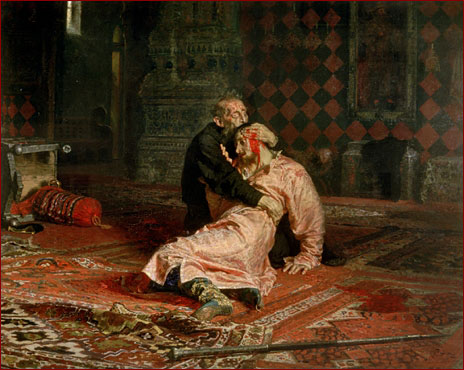
ivan the terrible and his son ivan.


i don’t even know what to do with this. other than maximize it so the image fills the screen, and i can stare and stare. it’s by ilya repin, (the 19th-century russian dude who painted they did not expect him, of which i wrote briefly and terribly last summer, in trying to explain why i’ve a deeper and more complex attachment to it than any other painting.) this one is called ivan the terrible and his son ivan on friday, november 16, 1581, though it’s better known as


ivan the terrible killing his son.


i marvel at how much emotion is right there. this is a guy, ivan the t, and t is for terrible. it seems likely that, at some point, he laid out a map, circled all the places where people will never ever give up, no matter how grim the odds, and started wars with them. really early on he did some good things: he was made tsar at 16, and he destroyed the world’s biggest slave market, which he then balanced out by making it illegal for peasants to go places.


(ivan the t at the appetizer table in hell: likewise, it’s nice to meet you, george. what kinds of things did you do during your career? oh, you co-sponsored a failed bill to make it harder for the mexicans to get in? bet that was real fun, yeah. guess what: i co-sponsored serfdom. introduced it on the motherfucking block, so suck it. have a baby carrot.)


there’s a lot of info out there about ivan the t's near-death illness and loss of his first wife, and it was after this that the schizoid stuff began in earnest. the painting moved me, and i read several pages about him; but i didn’t really come closer to knowing what emotion it is i feel for this man when i look the work. i—i cannot help but feel his despair: it’s right there, alive; and punishing. i have a glimpse of empathy for this man. ivan the t. who, according to wikipedia,


beat his pregnant daughter-in-law for wearing immodest clothing, causing a miscarriage. his son, upon learning of this, engaged in a heated argument with his father, which resulted in ivan striking him in the head with his pointed staff, causing his son's (accidental) death.


repin put it all there—wild, full cognition of all he's done, up to and including that moment. just in his face. i've found that when i look at it for long, my heart rate bumps up, then i keep looking, still longer; and my pulse cycles back down, till i'm very calm, and aware of it. i want to pray.